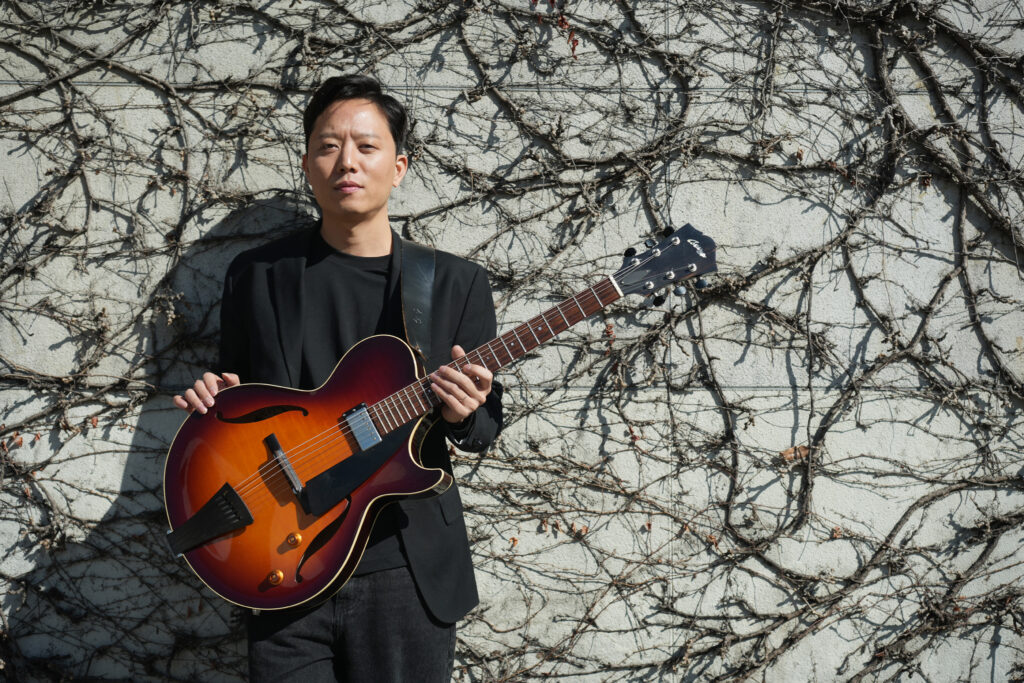
Jin Soo Kim (JSKM) is a guitarist, composer, and educator based in Seoul, South Korea. Born on February 20, 1984, he began playing guitar at the age of twelve and was introduced to jazz in 1999 through Seoul Jazz Academy. From his teenage years, he actively performed in local clubs, developing his musical voice through live performance rather than predefined stylistic systems.
In 2002, Kim entered Chugye University for the Arts as a creative writing major, studying modern poetry. This early engagement with language, structure, and narrative continues to influence his musical thinking, particularly his sensitivity to form, timing, and flow within improvisation.
At the end of 2003, Kim moved to the United States to study at Berklee College of Music, where he worked with Mick Goodrick, Hal Crook, George Garzone, Tim Miller, and Bruce Saunders. He later continued his studies at the New England Conservatory, studying with Jerry Bergonzi, John McNeil, Frank Carlberg, and Ted Reichman. During this period, his focus gradually shifted from stylistic mastery toward a deeper interest in interaction, embodiment, and the physical experience of sound.
Rather than completing his degree at NEC, Kim returned to Korea and transferred to Dongguk University, majoring in Arts Management. He later pursued doctoral studies at Korea University, earning a Ph.D. in Culture and Arts Studies. His academic research explores embodiment, musical gesture, and interaction in improvised music, expanding his practice beyond performance into theory, education, and cultural context.
Alongside his academic path, Kim founded the independent record label Koni Music, which later evolved into OLF, as a platform for artist-driven production and long-term documentation. As a bandleader or co-leader, he has released more than ten recordings, including full-length albums, EPs, and singles.
His discography spans a wide range of musical formats and aesthetics. Early releases such as Awareness (2008) focus on composition-driven duo works for guitar and percussion, emphasizing texture, space, and form. Song-based albums including Parangyebo (2014) and Flow Flow Flow (2017) present his work as a singer-songwriter, where composed material and improvisational phrasing coexist. Later projects further expand this spectrum: Cosmic Butterfly (2020) explores collective sound and open form through ensemble interaction; Trio (2021) documents live small-group improvisation; WELL (2022) treats improvisation as a shared structural force within an ensemble; and 변하는, 변하지 않는 (Changing, Unchanging) (2025) captures live trio performances that balance continuity and transformation.
While not all of his projects are strictly jazz recordings, improvisation remains a consistent underlying approach throughout his work, shaping not only solos but also texture, form, and musical decision-making.
Kim’s work as a performer has been recognized through major distinctions, including the Best Creativity Award at the 7th Jarasum International Jazz Concours and Guitarist of the Year at the 2015 Leaders Poll. He has performed at leading festivals and venues such as the Jarasum International Jazz Festival, Seoul Jazz Festival, as well as numerous concert halls, jazz clubs, and broadcast programs nationwide. In addition to his own projects, he has been active as a session musician and collaborator across jazz, popular music, and contemporary improvised music.
He is also engaged in concert planning and curation, developing performance contexts that emphasize listening, interaction, and musical dialogue over stylistic categorization. As an educator, Kim has taught guitar, ensemble, and improvisation at institutions including Hanyang University, Howon University, and Dongduk Women’s University, among others. His teaching focuses on musical awareness, response, and embodied listening rather than memorized patterns or technical routines.
Today, Jin Soo Kim’s practice moves fluidly between performance, composition, education, research, and production. Sonic Dialogue functions as a central hub where these activities converge—an open archive documenting an ongoing exploration of sound, response, and improvisation.